
Home Platforms Others Will Rubio’s Middle East Tri...
Others
CIO Bulletin,
24 June, 2026
Author:
Sambhrant Das
High level defense delegations deploy advanced monitoring arrays and enforce strict funding guardrails to preserve long term maritime trade security
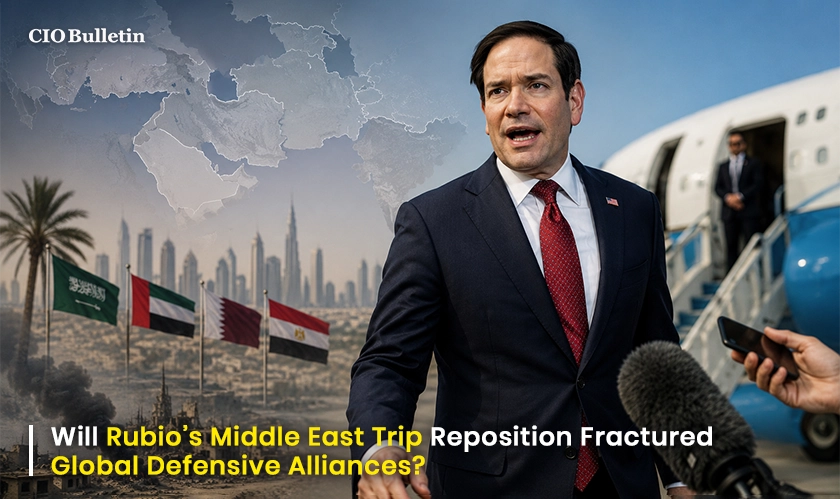
The geopolitical architecture governing Western security frameworks is undergoing immediate recalibration as top administrative envoys launch urgent regional stabilization campaigns. To deal with the growing friction around the just-negotiated cross-border security agreements, top defense and foreign policy dignitaries are engaging in direct, face-to-face talks with key security allies. US Secretary of State Marco Rubio started a significant three-nation Middle East trip by touching down in Abu Dhabi, to sit down with local officials for high-stakes discussions. This wide diplomatic push is meant to address the mounting worries among neighboring partners, who think the recent multilateral concessions on advanced weaponry and financial liquidity could end up giving regional rivals greater room to maneuver.
Gulf administration architects are demanding absolute transparency regarding the hidden clauses of the temporary truce intended to conclude recent severe regional conflicts. Local security networks, which previously sustained heavy drone and missile strikes, remain deeply skeptical of the extensive economic relief packages currently being offered to opposing forces.
Funding Accountability Measures: Regional leaders want tougher international compliance monitoring before the planned three-hundred-billion-dollar reconstruction pool gets released.
Defensive Corridor Guarantees: Coastal defense units are asking for clear, ironclad maritime protection setups so transit can stay open across the crowded Strait of Hormuz without interruption.
Managing the complex diplomatic fallout requires balancing necessary economic concessions against the core security anxieties of traditional international allies.
“Major economic relief initiatives remain entirely conditional on systemic behavioral changes from opposing state actors.” – Marco Rubio
Beyond basic diplomatic memorandums, forward-thinking defense networks are integrating modernized containment frameworks to counter deteriorating regional security. The broader Rubio Middle East trip aims to harmonize regional intelligence grids and establish definitive tracking platforms across volatile border territories.
Specialized defense teams are formulating shared tactical strategies to permanently halt the cross-border distribution of automated drone components.
Participating coalition nations are implementing dual-authorization tracking mechanisms to monitor unauthorized funding channels linked to non-state militant factions.
Because modern commercial trade relies entirely on unimpeded maritime logistics corridors to prevent global supply chain asset losses, legacy security arrangements must be replaced immediately. Shifting away from isolated national border defense models toward deeply integrated, tech-driven regional tracking frameworks is becoming an essential directive for global biosecurity and intelligence architects. Overhauling underlying multilateral defense networks ensures that partner states preserve stable trade volumes while shielding critical resource hubs from asymmetric security threats. CIO Bulletin views this development as a defining geopolitical test that will determine whether modern de-escalation frameworks can truly maintain stable maritime trade while preserving the trust of long-standing international allies.


















 consultants ltd.jpg)


Comments