
Home Technology Security Can Syria Security Council Ext...
Security
CIO Bulletin,
26 June, 2026
Author:
Sambhrant Das
How the unanimous extension of the UN border mandate shields Syria’s fragile internal political transition from external regional escalation
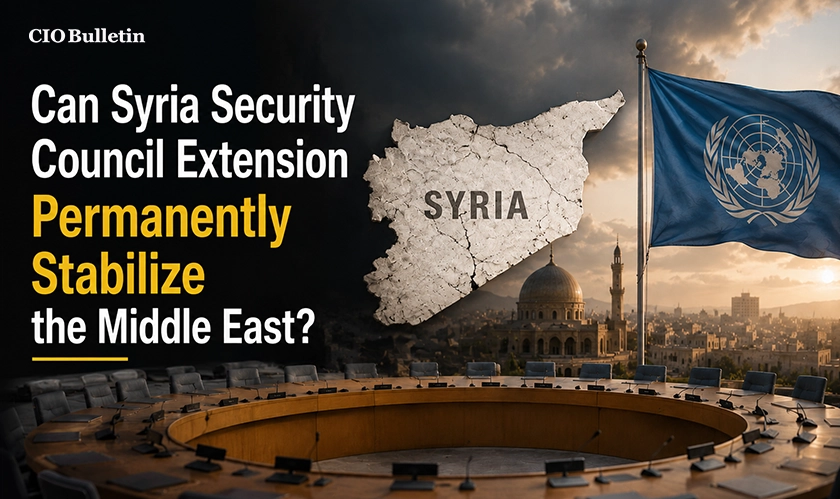
The United Nations is actively doubling down on its well-known peacekeeping presence along the volatile Golan Heights to manage deeper and persistent geopolitical rivalries. In a straightforward legislative move, the 15 member Syria Security Council voted unanimously and adopted Resolution 2824, which extends the mandate of the UN Disengagement Observer Force for another six months. Officially, the operation stays in place until December 31, 2026, and it is assigned to keep an eye on the 1974 buffer zone, while insisting on strict military restraints and similar limitations. Through this diplomatic consensus, the international body is aiming to reduce local friction and stop wider cross-border escalations between nearby militaries.
The mission was set up right away after the 1974 Disengagement of Forces Agreement, so it has a historic basis. It supervises a tangled system of demilitarized zones and troop limits that are pretty strict. Today’s work is not simple either, because newer external cross-border interventions may undermine brittle, local understandings.
The formal resolution demands that all participating factions immediately implement the historical ceasefire terms.
International monitors also make it explicit that any unauthorized military maneuvering is not allowed inside the Area of Separation.
Upgraded observation outposts are built for early detection protocols, to manage potential flashpoints before they grow out of control.
Addressing the chamber directly, Syrian diplomats emphasized that domestic stabilization efforts are yielding tangible administrative progress despite lingering regional volatility. Officials pointed to comprehensive national reconstruction initiatives and expanded international diplomatic cooperation as proof of internal normalization.
“Syria today is among the most stable countries in the region,” - Ibrahim Olabi, Permanent Representative of Syria to the UN.
He highlighted that Damascus is actively advancing its legislative infrastructure while cooperating fully with global monitoring agencies on regional security and counter-terrorism programs.
The diplomatic extension occurs alongside intensive internal transitions, as a special transitional parliament works to implement sweeping legislative reforms. UN briefings indicate that the nation's political landscape is navigating a highly sensitive phase where institutional progress and security vulnerabilities exist simultaneously.
Transitional authorities are actively updating domestic commerce regulations to combat persistent systemic inflation.
Dedicated committees are reviewing executive maneuvers to ensure diverse community representation across provinces.
Newly established parliamentary seats are expanding regional legislative inclusion to solidify long-term social cohesion.
Maintaining an uninterrupted, internationally backed observer network allows the state to pursue domestic economic recovery without risking sudden external border collapses. These ongoing monitoring extensions offer an essential administrative safety valve, preventing routine border disputes from triggering wider, multi-theater conflicts. According to CIO Bulletin, this development implies that holding on to strict, decades-old international security templates is crucial for shielding today’s urban and local recovery from sudden geopolitical destabilization and other abrupt shocks.
Everything you need to know about this news
The 15-member council voted unanimously to approve Resolution 2824 and extend the UN Disengagement Observer Force (UNDOF) until December 31, 2026.
UNDOF was set up in May 1974, after the Disengagement of Forces Agreement between Israel and Syria. The mission was intended to help end the Yom Kippur War, and it focuses on keeping the ceasefire in place along with supervising the demilitarized Area of Separation.
Ambassador Ibrahim Olabi stated that Syria is now among the most stable states in the region. He also pointed out that Damascus is concentrating on economic rebuilding, widening its partnerships with UN member states, and dealing with regional security matters.
Syria is in a sensitive transitional stretch after recent legislative expansions. UN Deputy Special Envoy Claudio Cordone noted that the transitional parliament is expected to debate new legislation, review executive measures, and make sure multiple local viewpoints are included.
Since regional tensions are rising, keeping a neutral UN observer force nearby reduces the risk of accidental military incidents. The mission offers an important communication and liaison pathway, so that small border problems don’t spiral into larger international confrontations.








 consultants ltd.jpg)


Comments